
DAYTON — Good Sunday evening, everyone! Weather Specialist Nick Dunn here with you to take a look at something you may see in the sky early this week. It has been a while since we last spoke of it, but do you recall the Northern Lights? If so, you might enjoy the rest of this story as we look ahead to a chance to see them this week!
So, what happened to bring the chance? We look to the sun! A coronal mass ejection (CME) occurred from a sunspot that was facing Earth. Keep in mind, the sun is over 90 million miles away from us. That alone makes predicting the path, speed, and intensity of these CME’s rather tricky! Modeling is limited and can be inconsistent.

As a refresher, as solar storms move towards Earth, they can enter our atmosphere at the poles of Earth where the magnetic field is weakest. From there, as the charged particles interact with oxygen and nitrogen molecules in the atmosphere, the end result are the pretty colors some of you recall from last year in particular.
We are slowly trending away from what we call solar maximum. this is where the number of sunspots are at their peak every 11 years or so. The number of sunspots (and solar storms) will decline until the next solar maximum occurrence in about 11 years.
[DOWNLOAD: Free Storm Center 7 Weather app for alerts as news breaks]
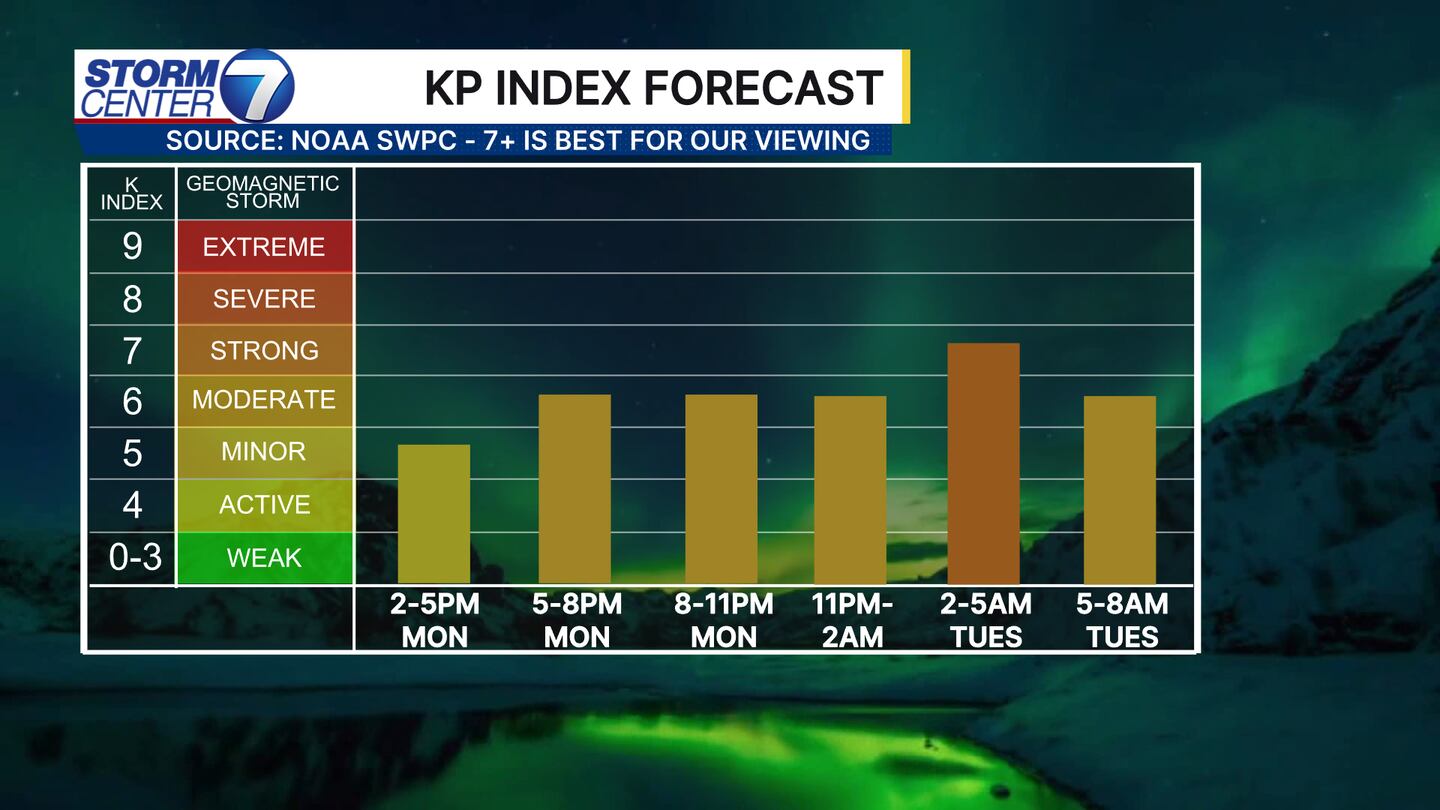
We can look at a few tools to analyze potential future chances for the northern lights. One of those is the KP Index forecast from the NOAA Space Weather Prediction Center. While this can be a good guide, I recommend not using this as the sole tools for any viewing opportunities. Solar storms do not run on a time schedule, and modeling is not updated as frequent as general weather forecasting. There are other current tools that measure solar winds and proton levels that we will be using to check on the status.
The current window for viewing would be after dark Monday night through the pre-dawn hours on Tuesday morning. It would not be a constant, all-night display. So, some patience is required!
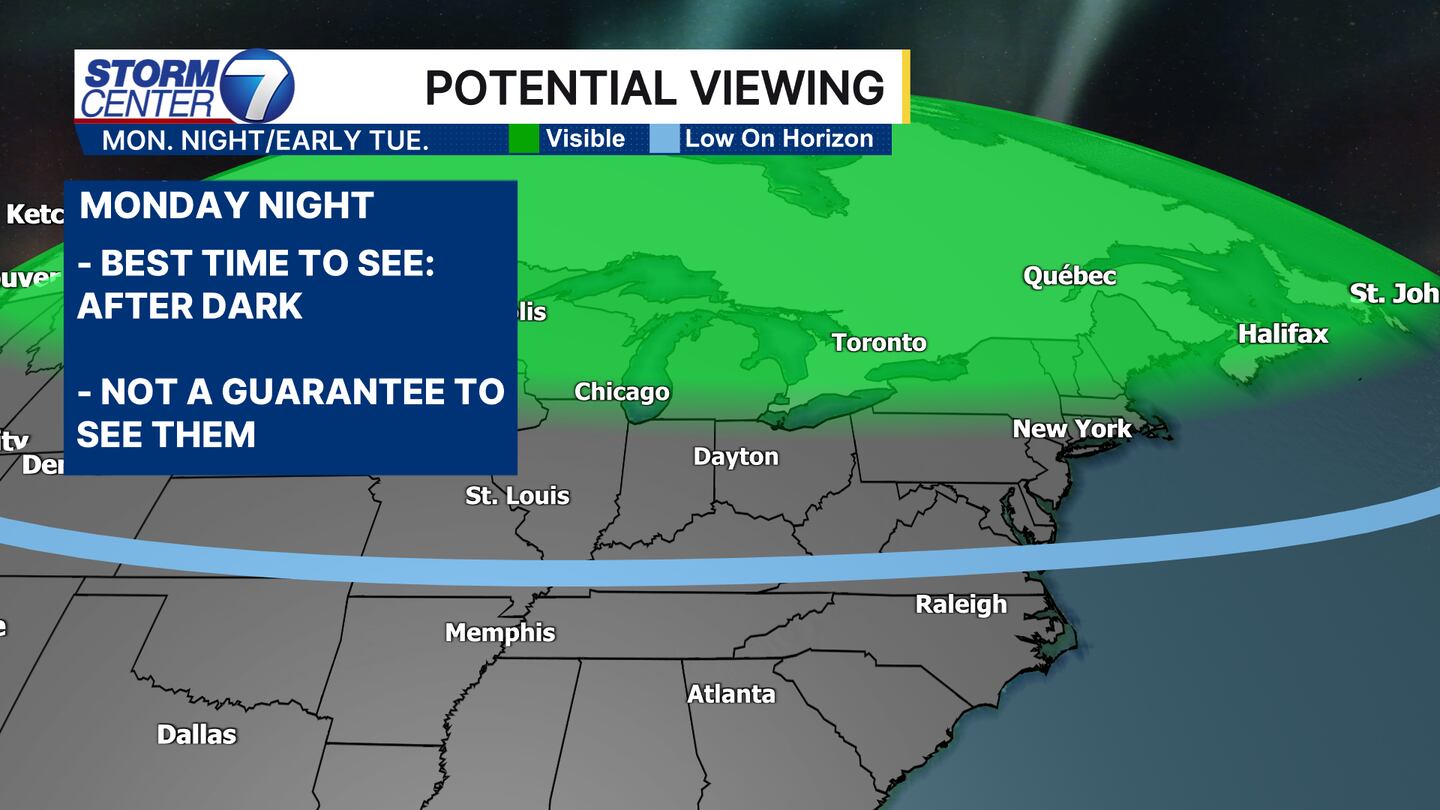
A couple reminders for you! First, keep expectations low! Auroras are fickle and while the excitement is fun, it is a good reminder that this is not a guarantee. Second, for getting photos, find a spot looking north with a clear view of the horizon away from city lights. Third, be sure to increase the exposure settings on your camera (smartphones, too!) and allow night mode to be on.
[WATCH Storm Center 7 Weather on the following devices]
I hope this comes together as it is awesome to look at how this all works! Many of you enjoyed spectacular displays last year, so let’s see if we can get one in tomorrow night! The sky will be clear, which works in our favor. Good luck!


